
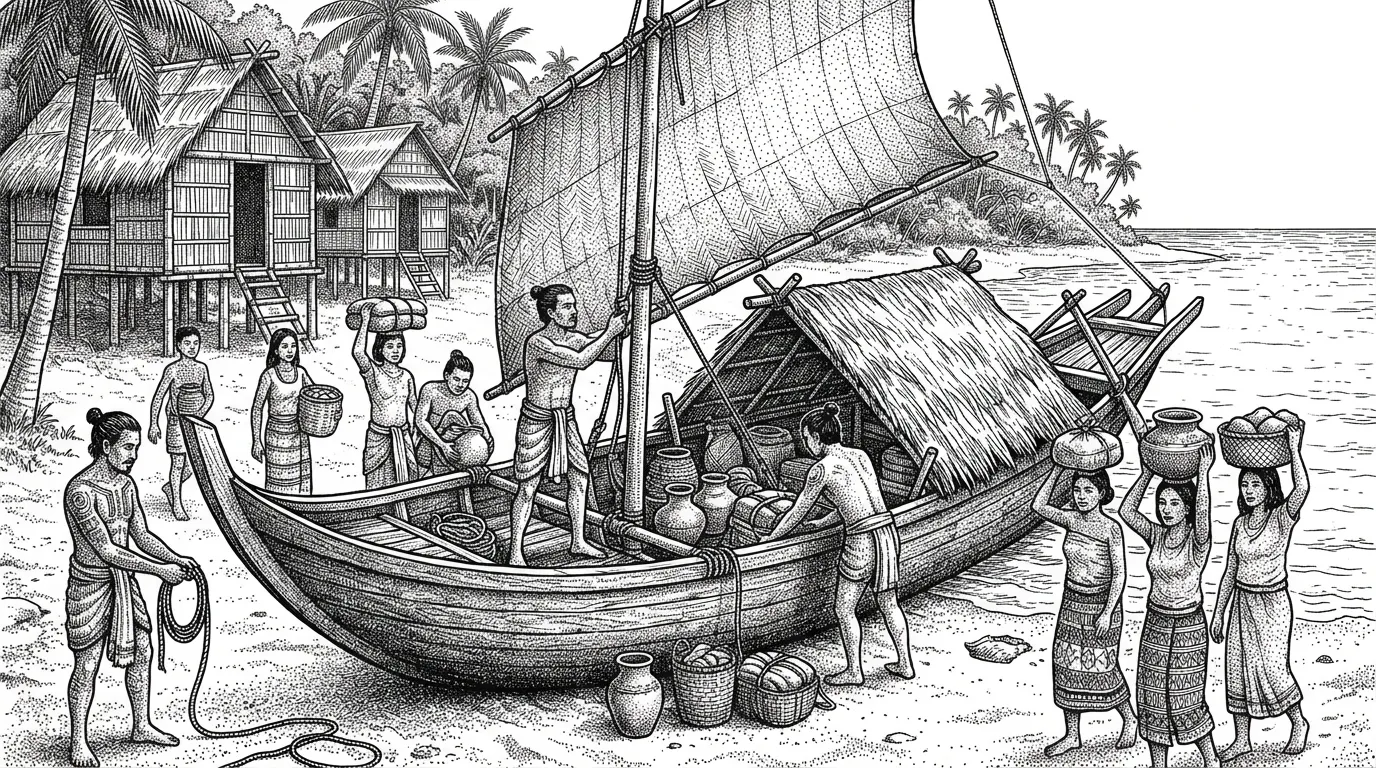
It takes a certain humility to admit that one’s own heritage lay overlooked for nearly half a century. In the Philippine public schools of my youth, social studies lessons repeated themselves with dependable regularity. Year after year,printed on rough paper that smelled of vinegar and pulp, we read about an ancient vessel named the Balangay. We took in the facts as brief, harmless curiosities, never suspecting the vast maritime legacy sitting just beneath the printed line.
It was only recently—now well past the mid-century mark of my own life—that I stopped to look closely at what that boat actually was. To discover in one’s fifties that one’s ancestors were not merely lucky drifters on the tide, but master shipwrights and oceanic architects, produces a feeling that sits somewhere between awe and self-reproach. If there were a civil tribunal for cultural negligence, I should plead guilty without defense and accept a thorough whipping in the derriere. We were maritime experts of the highest order, and I had treated the news as a third-grade memory exercise.
Consider how these ships were actually put together. If tasked with building a watercraft to cross an ocean today, most people would head straight for galvanized nails, steel bolts, and waterproof sealant. The ancient shipwrights of Butuan took a remarkably different approach: they used no metal at all. Long before Europeans brought their heavy ironware to Southeast Asia, precolonial craftsmen shaped hardwood planks with hand axes and carved tiny wooden pegs to fit them together.
The joinery was an engineering marvel. Planks were fitted edge-to-edge, drilled with precision holes, and bound tightly with coconut husk fiber and tough plant vines. This lashed-lug and sewn-boat method produced a vessel that was strong, yet entirely flexible. Where a rigid European galleon would fight the pounding ocean waves, the Balangayflexed, riding over the swells with remarkable grace.
And what a bustling world these boats created. Dating from as early as the tenth century, the eleven excavated hulls in Agusan Del Norte reveal that Butuan was not a sleepy fishing village patiently waiting for foreign mapmakers to arrive.It was a thriving, cosmopolitan trade hub. A tenth-century resident could walk down to the harbor and find merchants trading fine Chinese porcelain, Thai stamped pottery, Persian glassware, and intricate gold ornaments crafted right on the shore.
The Balangay held this sprawling maritime network together. Navigating without magnetic compasses or GPS, native sailors read the star patterns, studied the flight paths of sea birds, and felt the warm ocean currents through the soles of their feet. They rode the monsoon winds like clockwork, linking Mindanao to Borneo, Java, Sumatra, and beyond—turning the vast Pacific into a shared neighborhood.
Yet, in our collective memory, the Balangay was allowed to sink beneath colonial history. Our textbooks, shaped by centuries of looking outward for validation, treated pre-Hispanic life as a brief prelude rather than a foundation. The physical remnants of the boats themselves are fragile things. To preserve wood that has slept in wet earth for a millennium requires chemical treatments, controlled oxygen, and museum cases. Most of us will never stand beside those darkened, ancient timbers in person.
Which brings me to the small icon resting on this website, ditse.org.
When it came time to choose a mark for this digital space, I returned to that ancient hull. In a world connected by fiber-optic cables and invisible signals, the Balangay feels strikingly modern. It represents the original network—a vessel designed not just to transport goods, but to carry culture, language, and community across open waters. The word barangay, our fundamental unit of society, comes directly from this boat. Towns were not built around public squares first; they were built around the wooden ribs of the ships that brought people together.
I place the Balangay here as a quiet act of restitution. It is a reminder to myself, and perhaps to anyone who lands on this page, that we carry deep currents within us, even when we are slow to recognize them. We do not need modern satellite receivers to know where we are going, so long as we remember the sophistication of those who sailed by the stars before us.
It took me nearly fifty years to look beneath the simple textbook drawing and find the living vessel underneath. The boat under the name is small on the screen, but in the mind, it carries a very proud cargo.
comments
00